St. Laurentius (Cologne-Ensen)
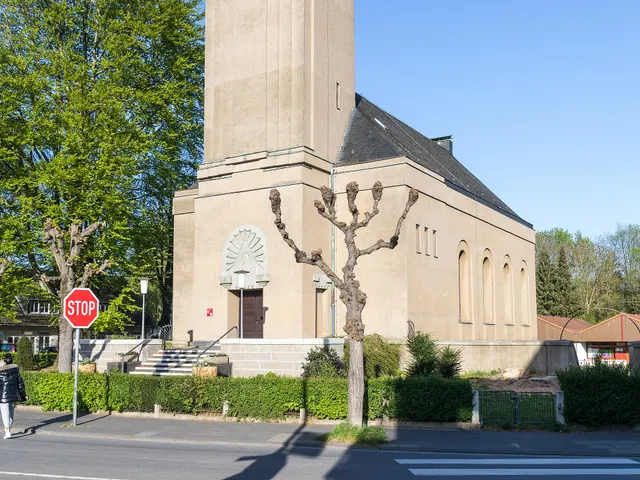
Neo-Gothic parish church in Ensen with a 56-metre tower and an unusual 'Christ at Rest' figure lacking nail and side wounds.
St. Laurentius is a Catholic parish church in Cologne-Ensen, named after Lawrence of Rome. The neo-Gothic building was constructed between 1894 and 1896 to designs by Theodor Kremer.
Source: Wikipedia
At a Glance
- Type
- Catholic parish church, neo-Gothic
- Built
- 1894–1896
- Architect
- Theodor Kremer
- Tower
- 56 metres tall
- Location
- Ensen district, Porz borough
- Listed
- Protected monument in North Rhine-Westphalia
- Parish
- Porzer Rheinkirchen parish association
The current organ is a hybrid spanning two eras: parts of the original instrument purchased in 1909 survived the war and were incorporated into the rebuilt organ – meaning some of its pipes have been sounding for over 115 years.
Architecture
The floor plan is a three-aisled hall church with a recessed choir. The building is crowned by a saddle roof with cross gables and a ridge turret. The square tower features corner turrets and is topped by an octagonal spire. The stained-glass windows were designed by Paul Weigmann and the firms Franz Melchior (Cologne), Derix (Düsseldorf), and Hein Derix (Kevelaer), and were installed in two phases.
History
The church was heavily damaged by several bomb strikes during the Second World War, leaving only the outer walls standing. By 1951 it had been restored sufficiently to hold services again. The tower was renovated in 1965 and the rest of the building in 1984/85. A refurbishment in 1999/2000 gave the interior a new colour scheme.
Interior
Almost nothing from the original furnishings survived the war. Between 1965 and 1980 sculptor Sepp Hürten created the altar, ambo, tabernacle, and altar cross. The church also holds figures of St. Lawrence and the Virgin Mary. The organ's 21 stops across two manuals incorporate parts of the 1909 instrument by the Seifert firm of Cologne, which was destroyed in the war.
Christ at Rest
One of the church's most notable pieces is a figure of Christ at Rest in an unusual form: the Saviour wears a crown of thorns and bears the wounds of the scourging, but lacks the wounds from the nails and the lance — that is, neither the nail wounds nor the side wound are present.
Bells
The ring consists of four bells cast in 1957 in Gescher by Hans Hüesker (Petit & Gebr. Edelbrock). They hang from timber yokes in a steel bell frame, with the fourth bell on a straight steel yoke. The Angelus is rung by the Mary bell; the full peal sounds on Sundays and feast days.
Timeline
- 1894–1896Construction of the Neo-Gothic parish church, designed by Theodor Kremer
- 1909Acquisition of the organ by the Seifert company (Cologne)
- 1945Severe damage from bomb hits during World War II
- 1951Restoration to allow church services to resume
- 1957Casting of four bells by Hans Hüesker (Petit & Gebr. Edelbrock) in Gescher
- 1965Tower renovation; new altar installed
- 1984–1985Renovation of the remaining church building
- 1999–2000Complete renovation with new colour scheme for the interior
Map
Blue dots: other places nearby — tap to explore.
You might also like
Comments
- Loading comments…
Sources & links
Auto-generated, last verified: 2026-06-27