Alt St. Pankratius (Cologne-Worringen)
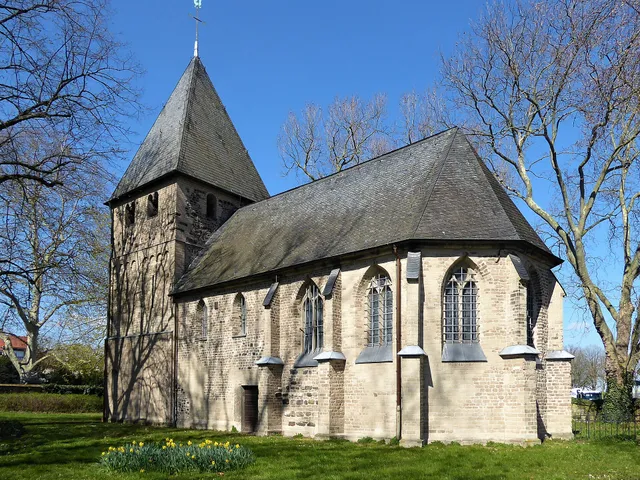
Former parish church of Cologne-Worringen with a Gothic nave and a controversially dated west tower — now converted into a residential house.
Alt St. Pankratius once served as the parish church of the Cologne district of Worringen. After religious services ceased in 1838, the building changed purpose several times — first becoming a school, and eventually a private residence with later additions.
Source: Wikipedia
At a Glance
- Type
- Former Roman Catholic parish church
- Location
- Worringen district, Chorweiler borough
- Structure
- West tower and single-nave church with polygonal choir
- Style
- Gothic architecture; dating of the tower disputed
- Dedicated to
- Saint Pancras (Pankratius)
- Current use
- Residential house
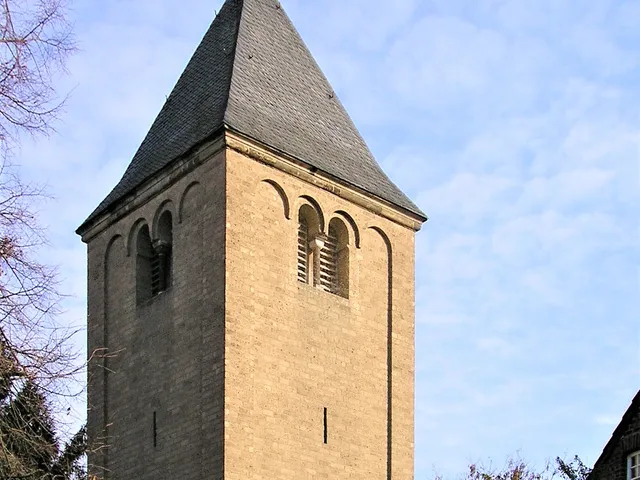
The tower's windows look Romanesque but aren't: the biforate windows were deliberately built around 1484 – during the Late Gothic period – in a historicising Romanesque style, after the church was damaged in the Neuss War of 1474.
History
The church is first documented shortly after 1300 in the Liber valoris, with the Cologne cathedral provost holding the right of patronage. In 1474, the building suffered damage during the Neuss War. When a new parish church dedicated to Saint Pancras was completed further west in 1838, the older structure was abandoned. A fire on 6 November 1859 destroyed the interior; the building was subsequently converted into a school, during which the northern aisle was removed.
Architecture and Its Dating
The dating of the west tower remains a matter of scholarly debate. Paul Clemen as well as Becker-Huberti and Menne classify it as a Romanesque structure from the 12th century. Dagmar Hötzel, however, interprets the interplay of basalt and brick as a counterpart to the nearby Zons fortress (1373/80), dating the all-brick upper storeys to around 1484; in her reading, the biforate windows would not be Romanesque at all, but rather Late Gothic work executed in a Romanesque idiom. The nave and its polygonal choir are unambiguously Gothic in origin.
Architectural Details
The buttresses of the nave have been preserved — double-stepped on the north side, single-stepped on the south. The choir, which terminates on three sides with octagonal edges, is supported by two-part buttresses. Since a survey from 1757 makes no mention of a northern aisle, it was most likely added after that date.
Timeline
- 1153Archbishop Arnold II acquires advocacy of Worringen; church not mentioned
- nach 1300First documented mention of Worringen church in the Liber valoris
- 12. Jh.Construction of the west tower (Romanesque)
- 1373/80Construction of nearby Zons fortress (comparative reference for tower form)
- 1474Church damaged during the Neuss War
- um 1484Construction of the brick upper storeys of the tower
- 1757Survey: north aisle not yet present
- 1838Church taken out of use, new parish church built
- 6. Nov. 1859Church burns out; subsequently converted into a school building
Map
Blue dots: other places nearby — tap to explore.
You might also like
Comments
- Loading comments…
Sources & links
Auto-generated, last verified: 2026-06-26