Kiesgrubensee Gremberghoven
A former gravel pit lake within Cologne's city limits, designated a nature reserve since 1989 – home to nesting kingfishers, sand martins, and great crested grebes.
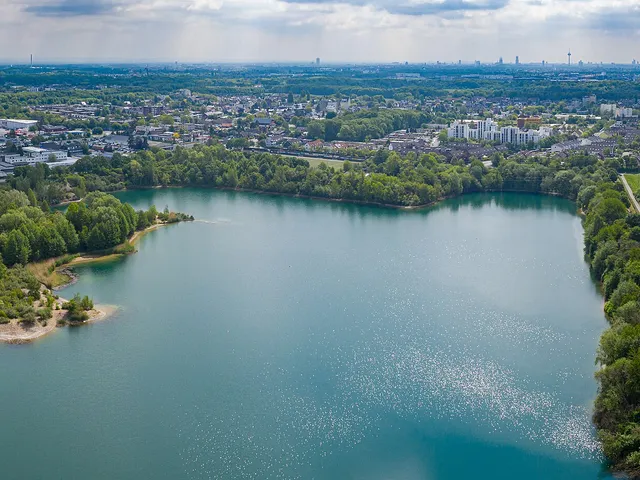
The Kiesgrubensee Gremberghoven is a designated nature reserve in Cologne that developed from a disused gravel pit and today serves as a habitat for a wide variety of animal and plant species.
At a Glance
- Type
- Nature reserve (former extraction lake)
- Size
- 37.65 hectares
- Designated
- 1989
- Location
- approx. 7 km from Cologne city centre and Bergisch Gladbach; approx. 10 km from Wesseling; approx. 11 km from Hürth and Troisdorf
- Highlight
- Nesting sites for kingfishers, great crested grebes, and sand martin colonies
- Transport
- S-Bahn station within immediate reach
Source: Wikipedia · retrieved 2026-06-24
Landscape and Habitat
The lake occupies most of the former pit; a small island rises from the water in the northern section. The shoreline is narrow, sandy-gravelly, and largely free of vegetation. Behind it, steep pit embankments rise up, supporting pioneer vegetation alongside mosses, fungi, and lichens, as well as planted shrubs. The eastern slope in particular displays pronounced escarpment collapses and open bare-soil areas. The predominant water body types are oligotrophic to mesotrophic calcareous lakes with benthic vegetation, including several species of stonewort algae.
Plant Life
The reserve is home to numerous plant species, including aquatic plants such as spiked water-milfoil, hair-leaved pondweed, fennel pondweed, and rigid hornwort, as well as pioneer species of bare-soil areas like coltsfoot, Canadian fleabane, and common mouse-ear. Woody species such as hornbeam, goat willow, silver birch, and Scots pine are also present.
Conservation Measures
The main threats to the site include recreational activities, fly-tipping, pollution, and unnatural water management. Protective measures include fencing off sensitive areas, restricting fishing and other leisure use, and removing litter. Parts of the site are also deliberately left to natural succession in order to preserve the lake as a habitat and stopover for migratory waterbirds.
Map
Blue dots: other places nearby — tap to explore.
You might also like
Comments
- Loading comments…
Sources & links
Auto-generated, last verified: 2026-06-25