Jan-Wellem-Denkmal
Bronze statue of Elector Jan Wellem in Cologne-Mülheim, donated in 1914 by the Andreae manufacturing family amid the controversy over the district's annexation.
The Jan-Wellem-Denkmal in Cologne-Mülheim depicts Johann Wilhelm of the Palatinate, known as Jan Wellem. The bronze figure was donated by the textile manufacturer family Andreae and created in the very year Mülheim was incorporated into Cologne.
Source: Wikipedia
At a Glance
- Type
- Portrait monument, listed building in North Rhine-Westphalia
- Subject
- Johann Wilhelm of the Palatinate (1658–1716), known as Jan Wellem
- Location
- Mülheim district and borough
- Figure height
- 3.15 metres
- Material
- Bronze
- Sculptor
- Eduard Schmitz
- Unveiled
- 28 April 1914
The monument was unveiled on 28 April 1914 – about 28 days after Mülheim's annexation by Cologne, which the donor had sought to prevent, and nearly two months before the actual company anniversary that served as the official occasion.
Occasion and Political Motivation
The donation came at the tail end of the dispute over Mülheim's annexation: the city had given up its fight for independence in 1913, and the merger with Cologne took effect on 1 April 1914. Officially, manufacturer Christoph Andreae donated the monument to mark his firm's 200th anniversary in Mülheim (1714–1914). That occasion, however, fades into the background — political motives are widely considered the driving force. The timing of the unveiling on 28 April 1914 supports this interpretation: roughly 28 days after annexation, but nearly two months before the actual anniversary date. The same Andreae family also donated Cologne's Bismarck monument during the Kulturkampf.
The Andreae Family and Mülheim
Many of Mülheim's craft and industrial businesses were owned by Lutheran or Reformed proprietors whose settlement in the area stemmed from the Elector's tolerant religious policy. The Andreae family itself was forced to leave Cologne in 1714 as Protestants. Their cloth manufactory, founded in Cologne in 1687, was relocated to Mülheim, where it received residency rights on 18 June 1714.
Appearance
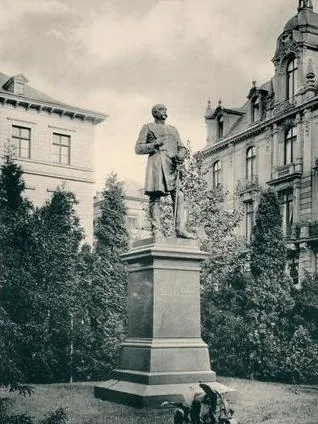
The 3.15-metre figure shows Jan Wellem in hunting attire — boots, rifle, and tricorn hat — standing on a Baroque-style pedestal bearing the Mülheim city coat of arms. Two plaques below read "Jan Wellem (1658–1716)" and "Unserem König 1711" ("To Our King 1711").
Jan Wellem and Mülheim
Johann Wilhelm visited Mülheim on several occasions, as the town lay on the route to Bensberg, and neighbouring areas were among his hunting grounds. During a visit in 1711 he was crowned Shooting King of the St. Sebastian Marksmen's Association and received a chain with a bird and shield.
Location
The monument originally stood on the southern side of Wiener Platz. After the Second World War it was moved to the Stadtgarten at the junction of Jan-Wellem-Straße and Fürstenberger Straße.
Timeline
- 1658Jan Wellem (Johann Wilhelm of the Palatinate) born
- 1687Andreae family founds cloth manufactory in Cologne
- 1711Jan Wellem visits Mülheim, becomes shooting king of St. Sebastianus association
- 18. Juni 1714Andreae family granted residency rights in Mülheim after Protestant expulsion from Cologne
- 1716Jan Wellem died (inscription on pedestal)
- 1913Mülheim city council votes for annexation by Cologne
- 28. April 1914Inauguration of the bronze statue by Eduard Schmitz, donated by Christoph Andreae
- nach 1945Monument relocated from Wiener Platz to Stadtgarten at Jan-Wellem-Str./Fürstenberger Str.
Map
Blue dots: other places nearby — tap to explore.
You might also like

Comments
- Loading comments…
Sources & links
Auto-generated, last verified: 2026-06-26