Zur Heiligen Familie
Deconsecrated orphanage church in Cologne-Sülz by Dominikus and Gottfried Böhm — featuring a 'children's orchestra' of 128 octagonal stained-glass windows.
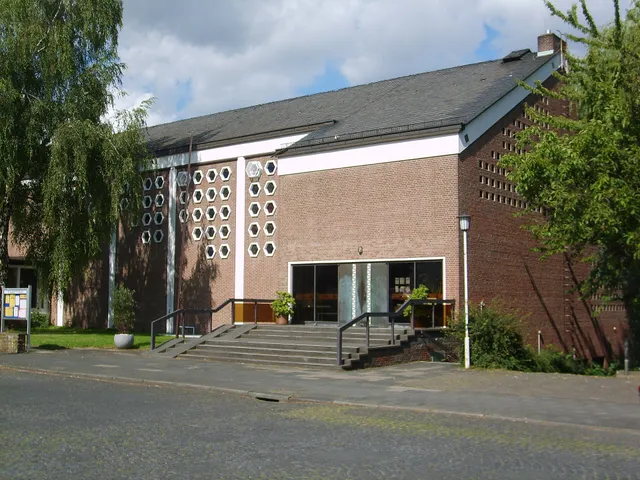
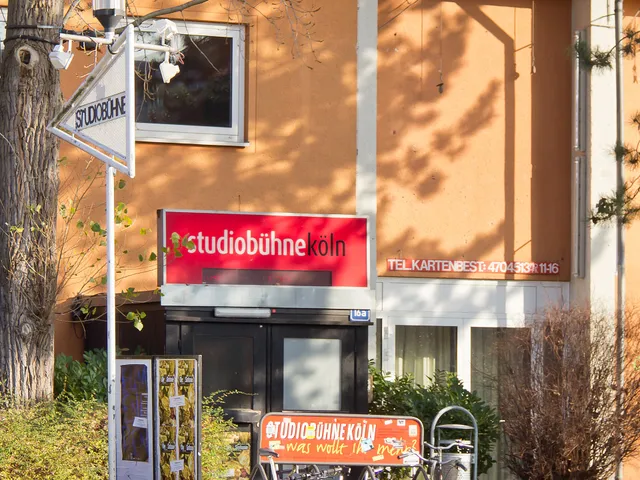
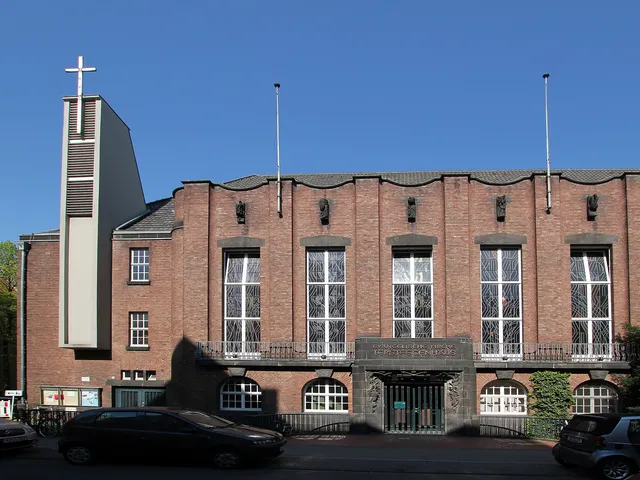
The former orphanage church "Zur Heiligen Familie" (Holy Family) in the Cologne district of Sülz once served the orphanage on Sülzgürtel. After 2010 it was deconsecrated and converted into a cultural and multi-purpose centre.
Source: Wikipedia
At a Glance
- Type
- former church, now a cultural and multi-purpose centre
- Location
- Sülz district, Lindenthal borough
- Nickname
- Orphanage Church
- Architects
- Dominikus and Gottfried Böhm
- Highlight
- 128 octagonal windows depicting a "children's orchestra"
- Listed
- heritage monument in North Rhine-Westphalia since 1989
- Owner
- City of Cologne
Gottfried Böhm – later the first German to win the Pritzker Prize – took over the commission after his father Dominikus died, and created a church interior encircled by 128 octagonal windows depicting music-making children, forming a complete glass children's orchestra surrounding the entire space.
History
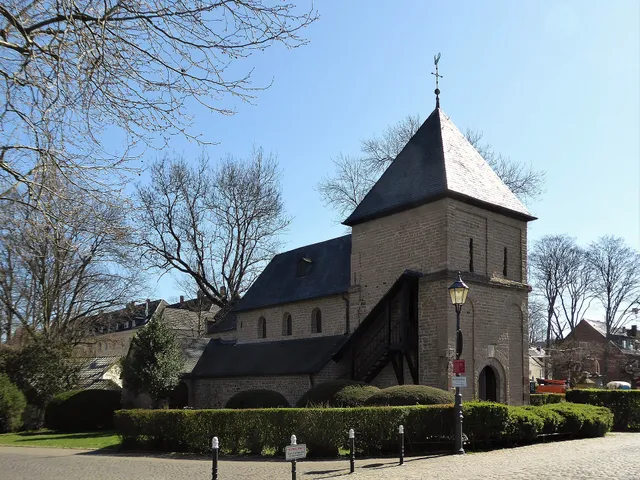
The neo-Baroque church formed the centrepiece of an orphanage built in Cologne-Sülz before the First World War. In the Second World War it was largely destroyed, with only the tower surviving. The commission for the new building went first to Dominikus Böhm; after his death, his son Gottfried Böhm took over and completed the structure, incorporating the surviving neo-Baroque tower. The guiding idea was a church for children — full of light and joyful symbolism.
Architecture and Interior
The outer walls were cast in poured concrete, partly using bricks salvaged from the destroyed original church. The main worship space sat on the upper floor above a hall of the children's home. Its rectangular interior was articulated by 128 octagonal windows whose floral and star-shaped patterns depicted singing and music-making children — a children's orchestra surrounding the entire room, with rosettes referencing the Holy Family. The choir wall is adorned with a relief by Jochem Pechau. The entrance side shows the Good Shepherd accompanied by a flock of 126 lambs and a sheepdog. The focal point was a raised altar baldachin supported by columns. Eva Burgeff created the tabernacle (1958) as well as a baptismal font with two adjoining holy water stoups.
Today
In 2007 the Rhenish Association for Monument Preservation named the church its Monument of the Month. Its last liturgical user was the parish of St. Bruno. During deconsecration from 2010 onward, the altar and baldachin were removed; pieces such as the tabernacle, organ, and pews were distributed to other parishes, museums, and storage. The built-in confessionals and the Stations of the Cross were kept in place.
Good to Know
The tower houses three small bells, the middle one of which is considered historically significant.
Timeline
- vor 1914Orphanage with neo-Baroque church built in Cologne-Sülz
- Zweiter WeltkriegChurch destroyed except for the tower
- 1951–1966Church reconstructed
- 1955Dominikus Böhm commissioned to design the new church
- 1956–1958Gottfried Böhm builds the current church
- 1958Tabernacle created by Eva Burgeff
- 1989Church listed as a protected monument
- Mai 2007RVDL names the church Monument of the Month
- nach 2010Deconsecration; conversion to a cultural and multi-purpose centre
Map
Blue dots: other places nearby — tap to explore.
You might also like
Comments
- Loading comments…
Sources & links
Auto-generated, last verified: 2026-06-27