Johanneskirche (Cologne-Sülz)
Protestant church in Cologne-Sülz from the early 1960s, featuring colourful hexagonal concrete honeycomb windows and a baptistery separated by glass walls.
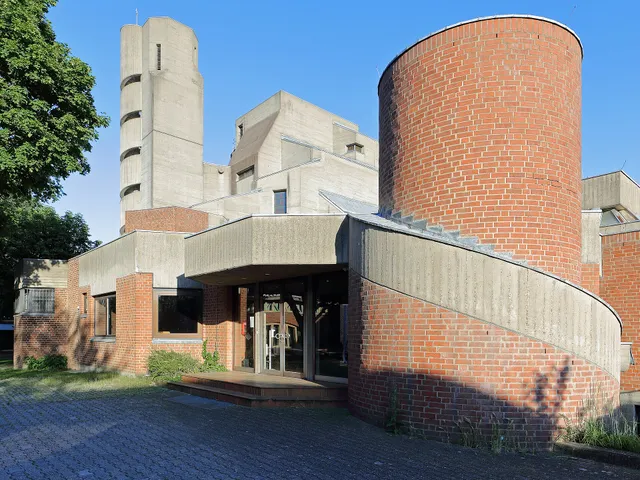
The Johanneskirche on Nonnenwerthstraße in Cologne-Sülz is a Protestant church built in the early 1960s. It serves the Cologne-Klettenberg congregation alongside the Tersteegenhaus as its second church.
Source: Wikipedia
At a Glance
- Type
- Protestant church
- Style
- Modernist
- Location
- Nonnenwerthstraße, Sülz district (Lindenthal borough)
- Foundation stone
- 1961
- Consecration
- 7 July 1963
- Architect
- Peter Graebner
- Named after
- the Evangelist John
- Seating capacity
- originally 460 to 520
The door handle at the main entrance is shaped like the Evangelist John pointing to the Bible – an unusual artistic detail that makes the church's namesake tangible the moment you arrive.
History
As Cologne grew and migration increased, the number of Protestants in what is now the Lindenthal borough rose steadily from 1871 through the 1960s, making a dedicated church for the Sülz and Klettenberg neighbourhoods necessary. A building association was founded in 1956, the foundation stone was laid in 1961, and the church was consecrated on 7 July 1963. The name was chosen because the incumbent pastor Schumann, who served from 1951 to 1972, devoted particular scholarly attention to the Gospel of John and the Book of Revelation.
Architecture
The site sits roughly three metres below street level, so the lower storey is below grade on the entrance side but fully above ground on the other three sides. The side walls consist of a reinforced-concrete frame with fair-faced brickwork, into which prefabricated hexagonal concrete honeycombs filled with coloured cast glass are set to admit light. The altar wall is formed by two masonry surfaces meeting at an obtuse angle. The building is topped by a shallow pitched roof clad in slate, beneath which fine hardwood panels line the interior. A planned 30.5-metre bell tower was deferred due to limited funds.
Interior & Furnishings
Just inside the entrance, a baptistery is separated from the nave solely by glass walls, preserving a visual connection to the main space. Above it sits a gallery housing the organ and ancillary rooms, while the sacristy adjoins the nave on one side. The colourful honeycomb windows bathe the nave in direct, jewel-toned light. The door handle at the main entrance is sculpted in the form of the Evangelist John pointing to the Bible. The altar is a solid block of exposed concrete topped with a natural stone slab; above it hangs a triumphant cross of metal adorned with lead crystal and amethyst nails, bearing the inscription "I am the bread of life (John 6:35)." The organ society was founded in 1967 and the instrument completed in 1974.
Today
Beyond regular Sunday services, the church hosts beat masses introduced by Pastor Uwe Seidel, as well as concerts by the Johanneskantorei choir. As of 2008, around 9,500 Protestants lived within the Cologne-Klettenberg congregation's area.
Timeline
- 1871Growth of Protestant population in the Lindenthal district begins
- 1956Church building association founded, preliminary planning begins
- 1961Foundation stone laid for the Johanneskirche
- 1963Church consecrated on 7 July 1963
- 1967Organ building association founded
- 1974Organ completed
Map
Blue dots: other places nearby — tap to explore.
You might also like
Comments
- Loading comments…
Sources & links
Auto-generated, last verified: 2026-06-26